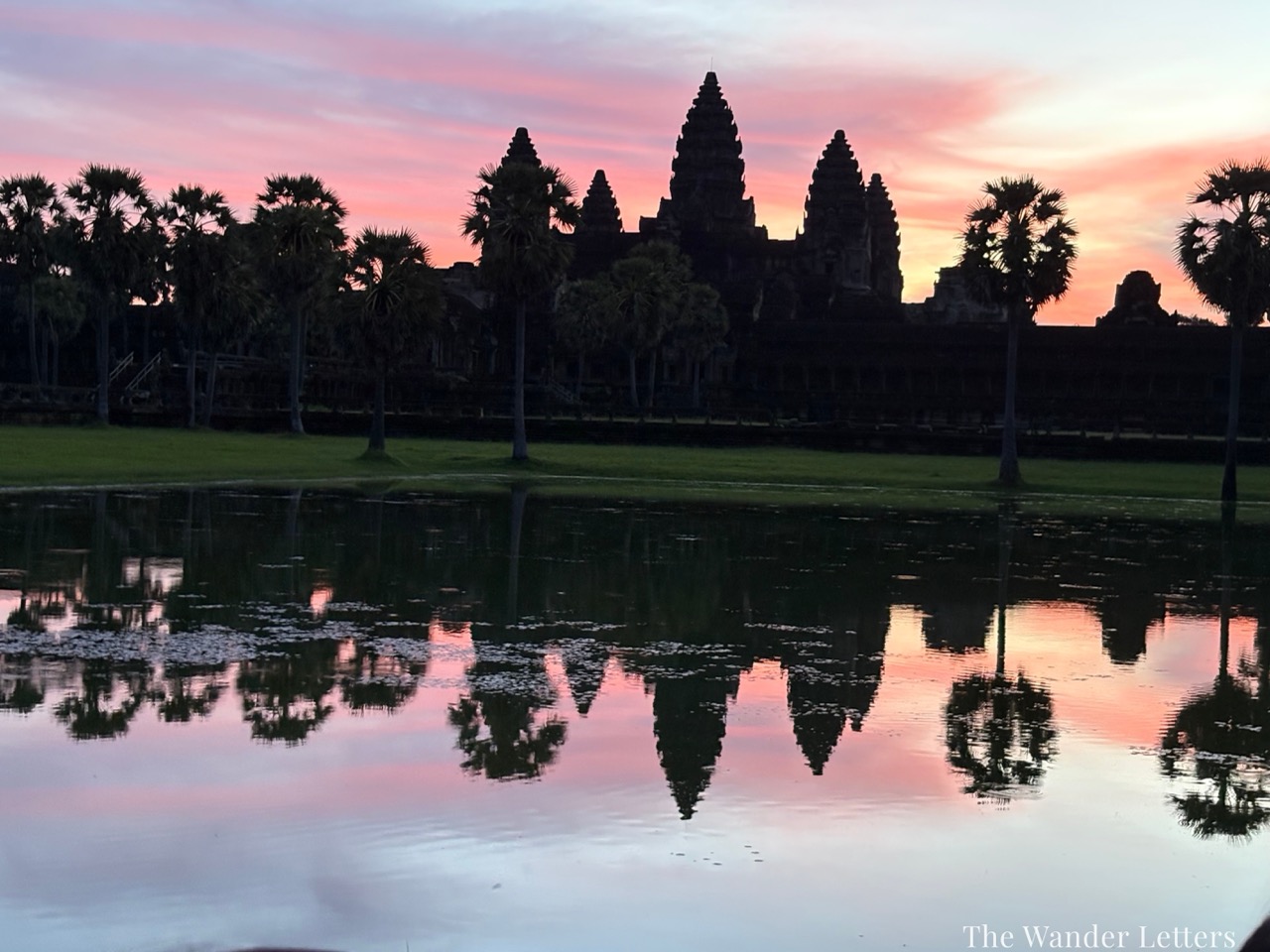
Siem Reap is a city that gives you a lot more than you expect. Most people come for Angkor Wat — and Angkor Wat alone is enough reason to make the journey. But the city around it, the food, the culture, the evening experiences and the smaller temples that most visitors rush past — together they create something that stays with you long after you leave.
Here are the best things to do in Siem Reap, in the order that made the most sense for our family of three.
1. Angkor Wat at Sunrise — 4am and Absolutely Worth It
This is not just the best thing to do in Siem Reap. It is one of the most magnificent experiences I have had anywhere in the world.
We left our hotel at 3.45am — our hotel had packed us a breakfast the night before without us asking, so we carried it with us. We reached the main gate by 4.15am, walked 15 to 20 minutes through the darkness to the reflecting pool, and waited.
The sky changes slowly. Grey, then the faintest pink, then a deep gold. And the silhouette of Angkor Wat emerges from the darkness — perfectly mirrored in the still water below. There is a moment when everything goes quiet. Even the crowds go quiet.
We spent about an hour at the reflecting pool before the sunrise was complete. Then we roamed around the main temple with our guide before moving on to the other temples.
Practical details:
- Book the activity Angkor Wat Sunrise before hand on Klook.
- Leave your hotel by 3.45–4.00am
- Angkor Pass required ($37 for 1 day) — buy the day before (Not required to buy if you book on Klook)
- Bring a light layer — it is cool before sunrise
- Carry water and a small torch for the walk in
- Breakfast is available from stalls near the complex — around ₹300 per person
2. Bayon Temple — The Temple of Faces
After Angkor Wat, Bayon was our second stop and it could not be more different. Where Angkor Wat is grand and symmetrical, Bayon is labyrinthine and slightly otherworldly.
The defining feature of Bayon is its 54 towers, each carved with enormous four-faced representations of the Bodhisattva Avalokiteshvara — or, as many historians believe, the king Jayavarman VII himself. Over 200 of these faces look out in every direction, serene and slightly enigmatic. No matter where you stand inside Bayon, you are being watched.
Our guide brought the temple to life by explaining the bas-reliefs — carvings along the outer walls that depict historical battles and daily life scenes in extraordinary detail. Without a guide, you might walk past them quickly. With one, you stop and stare.
Practical tip: Hire a guide for Bayon specifically — the history and symbolism here is rich and a good guide transforms the experience. If you buy the entire activity, all this is included.
3. Ta Prohm — Where the Jungle Fights Back
Ta Prohm is the temple most people picture when they think of jungle ruins — and the reality does not disappoint. This is where the roots of enormous silk-cotton and strangler fig trees have grown over, around and through the ancient stones for centuries, creating a visual that is equal parts beautiful and unsettling.
Unlike other Angkor temples, Ta Prohm was deliberately left in its partially overgrown state — the trees have become as much a part of the structure as the stones. Walking through it feels like stepping into a place where nature has quietly been reclaiming what was taken from it.
The light inside Ta Prohm is extraordinary in the mid-morning hours — filtered through the canopy, falling on old stone and twisting roots. If you have a camera, you will fill your memory card here.
Note: Ta Prohm was used as a filming location for the 2001 film Lara Croft: Tomb Raider, which brought it to international attention. You will recognise certain spots immediately if you have seen the film.
4. Banteay Srei — The Pink Temple
This is the temple most people skip because it is about 25 kilometres northeast of the main Angkor complex — a 45-minute tuk tuk ride. That is a mistake.
Banteay Srei is known as the Citadel of Women, or the Pink Temple, because of the distinctive rosy-pink sandstone from which it is built. Constructed in the 10th century, it is smaller than the other temples but the carvings are in a different category entirely — intricate, detailed and remarkably well-preserved after more than a thousand years. It is said that the carving was so fine it could only have been done by women’s hands, hence the name.
For anyone with an appreciation for craftsmanship and artistry — which is very much the spirit of The Wander Letters — Banteay Srei is unmissable.
Best time: Early morning or late afternoon, when the light turns the pink stone golden and the crowds are thinner.
5. The Apsara Dance Show with Dinner
This was the evening highlight of our Siem Reap visit, and I cannot recommend it strongly enough — especially for Indian travellers.
The Apsara dance is a classical Cambodian art form that tells stories from Hindu mythology — the Ramayana, the Mahabharata, the stories of gods and demons and divine battles that we grew up hearing. To see them told through Cambodian movement and costume, in a country that was once deeply connected to the Hindu Khmer Empire, was moving in a way I did not entirely expect.
The show runs for 3 hours and includes a dinner buffet that is genuinely lavish — a very wide spread of Cambodian and international dishes. Our tuk tuk pick up and drop from the hotel was included in the ticket price, which made the evening completely effortless.
Practical details:
- Book in advance — popular shows fill up
- Look for tickets that include dinner buffet and tuk tuk transfer
- Price approximately $30–40 per adult
- Duration: 3 hours
- Dress smartly — it is a sit-down performance evening
6. Pub Street & the Old Market (Phsar Chas)
Pub Street is Siem Reap’s beating heart after dark — a lively strip of restaurants, bars, street food stalls and souvenir shops that gives you an immediate sense of the city’s energy. Even if you are not a nightlife person, a walk along Pub Street at dusk is one of the best introductions to Siem Reap.
The Old Market, just steps from Pub Street, is where you find everything from Cambodian silk and silver jewellery to carved stone replicas, spices and local handicrafts. Take your time here — the stalls reward slow browsing and light negotiation is generally expected.
Good for: Souvenirs, local snacks, people watching and a cold Angkor Beer as the evening cools down.
7. Angkor National Museum
If you want to understand what you are seeing at the temples before or after your visits, the Angkor National Museum is the place to go. It covers the history of the Khmer Empire, the mythology behind the temple carvings and the significance of Angkor Wat in Cambodian culture and identity.
Housed in a beautiful modern building near the temple complex, it is particularly well-suited for families travelling with children — it brings context to what might otherwise be a series of impressive but disconnected stone structures.
Practical Tips for Siem Reap
- Start all temple visits early — the heat and the crowds both build through the day. The best light is always in the first hour after sunrise.
- Dress modestly for all temples — shoulders and knees must be covered. Light cotton layers are ideal.
- Hire a licensed guide for at least the main temple circuit. The history here is layered and a good guide transforms the experience. If you book the activity on Klook, everything is included – all temples and the pick up drop and the guide.
- Stay hydrated — Cambodia is hot, particularly in late September and October. Carry water everywhere.
- Use USD — small bills are essential. Always carry $1 and $5 notes.
- Angkor Wat pass is photo-based — carry your passport when buying it.
Siem Reap rewards those who slow down and pay attention. The temples are magnificent from the outside — but the carvings, the mythology, the light at different hours and the stories your guide tells are what make the experience genuinely unforgettable.
Also read: 2 Days in Siem Reap — Complete Itinerary | Angkor Wat Sunrise Guide | Siem Reap Budget Guide