
Hanoi reminded me of Pune.
Not in a bad way — but in a deeply familiar way. The density of it. The motorbikes weaving between cars and pedestrians with complete confidence. The narrow lanes lined with shops selling everything from street food to hardware. The noise, the energy, the sense that this city has been busy for a very long time and has no intention of slowing down.
We spent one full day and night in Hanoi, using it as a base before heading north to Sapa. Our hotel check-in was delayed due to a room issue, and Amara Hanoi Hotel and Spa arranged for us to stay at an alternative property nearby while it was sorted — a small inconvenience that actually gave us more time to wander than we’d planned.
Hanoi is not the most photogenic city in Vietnam. Phu Quoc has the beaches, Sapa has the mountains, Halong Bay has the karsts. But Hanoi has something different — a lived-in, layered quality that rewards walking slowly and paying attention. The lake in the middle of the city. The temple on the island. The street where trains once passed close enough to touch the laundry hanging from balconies.
Here is what one day in Hanoi looks like as an Indian traveller, honestly told.
Getting to Hanoi
By air: Noi Bai International Airport (HAN) is about 45 minutes from the city centre. Grab-cab is the easiest option — budget around 250,000–350,000 VND (~₹800-1,100) for the ride into town. Avoid unlicensed taxi touts at the arrivals hall.
Within Vietnam: If you’re coming from Ho Chi Minh City or Da Nang, domestic flights are frequent and affordable. From Sapa, the Sapa Express train is an excellent overnight option — we used it on our return and it was comfortable, punctual, and a genuinely pleasant experience.
Where to Stay in Hanoi
We stayed near the Old Quarter, which is exactly where you want to be for a short visit — everything worth seeing is walkable from there.
Our experience: Amara Hanoi Hotel and Spa was our booked hotel. Due to a room issue on arrival, the hotel arranged alternative accommodation for us nearby, which they handled without fuss. The location itself was excellent — close to the Old Quarter, Hoan Kiem Lake, and Train Street, all of which we walked to easily.
For a one-night transit stop, proximity to the Old Quarter matters more than the hotel itself. Pick anything well-reviewed in that area and you’ll be fine.
What to Do in Hanoi in One Day
1. Hoan Kiem Lake — the Heart of the City
Start here. Hoan Kiem Lake sits at the centre of Hanoi’s Old Quarter and is the city’s most peaceful spot — which is saying something in a place this busy.
The lake is small enough to walk around in 20-30 minutes. In the early morning and evening, locals gather here to do tai chi, walk laps, and simply sit by the water. It has a completely different rhythm from the streets around it — slower, quieter, almost meditative.
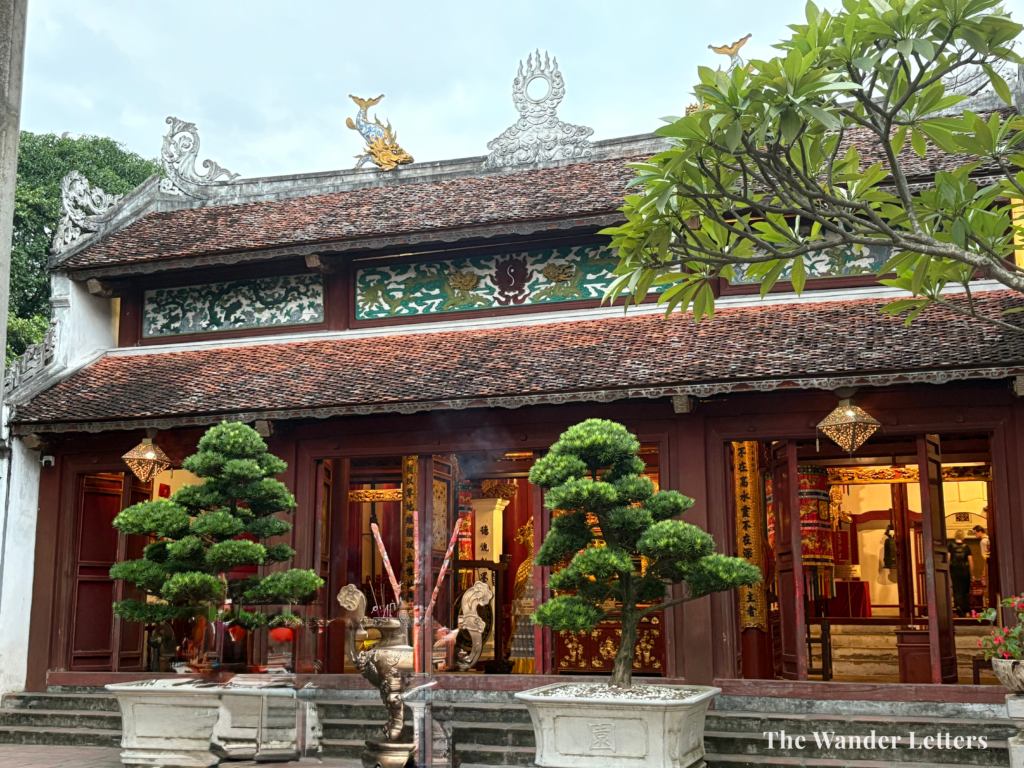
In the middle of the lake sits a small red pagoda called Turtle Tower. At the northern end, connected to the shore by a red painted bridge, is Ngoc Son Temple.
2. Ngoc Son Temple — the Island Temple
Cross the red Huc Bridge (The Sunbeam Bridge) and you’re on a small island in the middle of Hoan Kiem Lake. Ngoc Son Temple has stood here since the 18th century, dedicated to General Tran Hung Dao, scholar Van Xuong, and the sacred turtle of the lake.
Entry is a small fee — around 30,000 VND (~₹100). Inside you’ll find incense, offerings, and the preserved body of a giant turtle that was found in the lake in 1968. It is strikingly large — over 2 metres long — and is considered sacred in Vietnamese tradition.
The temple itself is compact and quickly explored, but the setting — water on all sides, the red bridge behind you, the city just visible through the trees — makes it one of those spots that’s more memorable than it looks on paper.
3. The Old Quarter — Just Walk
The 36 Streets of Hanoi’s Old Quarter were historically each dedicated to a specific trade — silk, paper, tin, bamboo. That system is mostly gone now, but the lanes still carry names from those trades, and the energy of commerce remains.
Don’t plan this too carefully. Just walk. Turn into any lane that looks interesting. You’ll find:
- Street food stalls selling pho, banh mi, and egg coffee
- Shops selling lacquerware, silk scarves, and hand-embroidered goods
- Tiny temples tucked between buildings
- Coffee shops with plastic stools spilling onto the pavement
We had lunch at a local restaurant that a local pointed us to — no English menu, food arrived fast and was genuinely excellent. That kind of meal is easy to find in the Old Quarter if you’re willing to point at what the next table is eating.
4. Train Street — Worth Seeing, Don’t Expect a Train
A narrow residential alley in the Old Quarter where the Hanoi-Ho Chi Minh City railway line runs directly between the houses. At its busiest, the train passes so close to the buildings that residents pull in their potted plants and fold back their chairs.
We walked to it — our hotel was nearby — and spent time looking at the tracks, the houses, the cafes that have sprung up along the alley for tourists. No train came while we were there, which is increasingly common since authorities have tried to restrict tourist access and train timings are unpredictable.
Go for the atmosphere and the photographs, not for the train itself. It’s a 10-minute detour from the Old Quarter and worth it either way.
Food in Hanoi — What to Try
Hanoi has its own distinct food identity, different from the south. A few things worth trying during one day:
Pho Hanoi — the original. Northern-style pho is clearer, less sweet, and served with fewer condiments than the southern version. Find it at any street stall open in the morning.
Bun cha — grilled pork patties and noodles in a light broth. Hanoi’s most famous dish. Available at lunch in most Old Quarter restaurants.
Egg coffee (ca phe trung) — strong Vietnamese coffee with a whipped egg yolk cream on top. Sounds strange, tastes remarkable. Giang Cafe near the Old Quarter is the most famous spot.
Banh mi — Vietnam’s legendary sandwich. Better here than almost anywhere.
We had a long, relaxed lunch at a local restaurant in the Old Quarter — the kind with a handwritten menu and a ceiling fan. The food was very good and very inexpensive. Hanoi eats well and doesn’t charge you much for it.
Hanoi for Indian Travellers — Practical Tips
Currency: Vietnamese Dong (VND). 1 USD ≈ 25,000 VND. Carry cash for markets, street food and small shops. ATMs are plentiful in the Old Quarter.
Getting around: Walking is the best option in the Old Quarter. For longer distances, Grab (the local Uber equivalent) is reliable, safe and inexpensive. Agree prices before getting into any unmarked taxi.
Crossing the road: This deserves its own paragraph. Traffic in Hanoi does not stop for pedestrians. The technique is to walk slowly and steadily — the motorbikes will flow around you. Don’t hesitate, don’t run, don’t wait for a gap that isn’t coming. Walk slowly and confidently. It works.
Weather: Hanoi has four seasons, unlike the south. November to April is cooler and drier (15-25°C). May to October is hot and humid with rain. If you’re heading to Sapa immediately after, pack layers regardless of season.
SIM card: Pick one up at the airport. Viettel and Vietnamobile both work well. A tourist SIM with data costs around 100,000-150,000 VND (~₹300-500).
Vegetarian food: Easier in Hanoi than in some Southeast Asian cities. Buddhist vegetarian restaurants (com chay) are scattered through the Old Quarter and are excellent.
Hanoi as a Transit Stop — Honest Verdict
If you’re combining Hanoi with Sapa and Halong Bay — as we did — you’ll likely spend just one night here. That’s enough to see the essentials: Hoan Kiem Lake, Ngoc Son Temple, Old Quarter, Train Street.
Don’t feel pressured to squeeze in the Ho Chi Minh Mausoleum, the Temple of Literature, or the Vietnam Museum of Ethnology on a single-day visit. Those are worthy of a longer trip. For a transit stop, the lake and the lanes are all you genuinely need.
Hanoi rewards a slower pace, and we didn’t quite have one. Next time, two nights, and a proper exploration of the museums and the French Quarter. But as a single day — it left an impression.
Getting from Hanoi to Sapa
We took the Sapa Express train from Hanoi to Lao Cai (the closest station to Sapa), then a private car transfer up the mountain. Total cost for the family of 3: approximately ₹5,000 for train tickets.
The train departs Hanoi in the evening and arrives in Lao Cai in the early morning — an overnight journey that’s comfortable, efficient, and far more enjoyable than you’d expect. Read our complete Sapa Travel Guide → for everything that came next.
Also Read
- Sapa Travel Guide — Fansipan, Cat Cat Village & the Train Back →
- Halong Bay Overnight Cruise Guide →
- Ultimate Vietnam Travel Guide for Indians →
- 15-Day Laos, Cambodia & Vietnam Itinerary →
Planning your Hanoi trip? Leave your questions in the comments — we read and reply to everything.